Car Inspection
How to Check Paint Quality on a New Car
Factory paint has a consistent signature. Learn how reflections, texture and a paint depth gauge tell you whether a panel left the plant that way — or was refinished on the way to you.
Cars are handled many times between the assembly line and your driveway — yard moves, rail and truck transport, storage, accessory fitment and pre-delivery cleaning. Minor cosmetic damage along that chain is not rare, and it is sometimes repaired locally before the customer sees the car. Paint inspection is simply the discipline of telling factory finish apart from later work.
Factory paint has a consistent signature
A production line applies coatings under controlled temperature, airflow and robot movement. The result is a texture — the faint dimpling known as orange peel — that looks the same across every panel of the same car. Refinished paint almost never matches that signature exactly.
- Texture mismatch — one panel visibly smoother or coarser than the panel beside it.
- Colour shift under angle — metallic and pearl finishes are the hardest to match; look along the panel, not straight at it.
- Overspray — fine paint mist on rubber beading, plastic trim, wheel arch liners or under the bonnet lip.
- Masking edges — a hard line of paint where tape was applied, often inside a door shut or on a pillar.
- Sanding marks — parallel fine scratches under the clear coat, visible with a torch held at a low angle.
The reflection technique
Stand so that a straight edge — a building line, a light strip, a pole — reflects along the length of the panel, then move your head slowly. On a straight factory panel the reflected line stays straight. Where filler or a heavy repaint sits underneath, the line bends, wobbles or breaks. This costs nothing and finds most of what matters.
What a paint depth gauge actually tells you
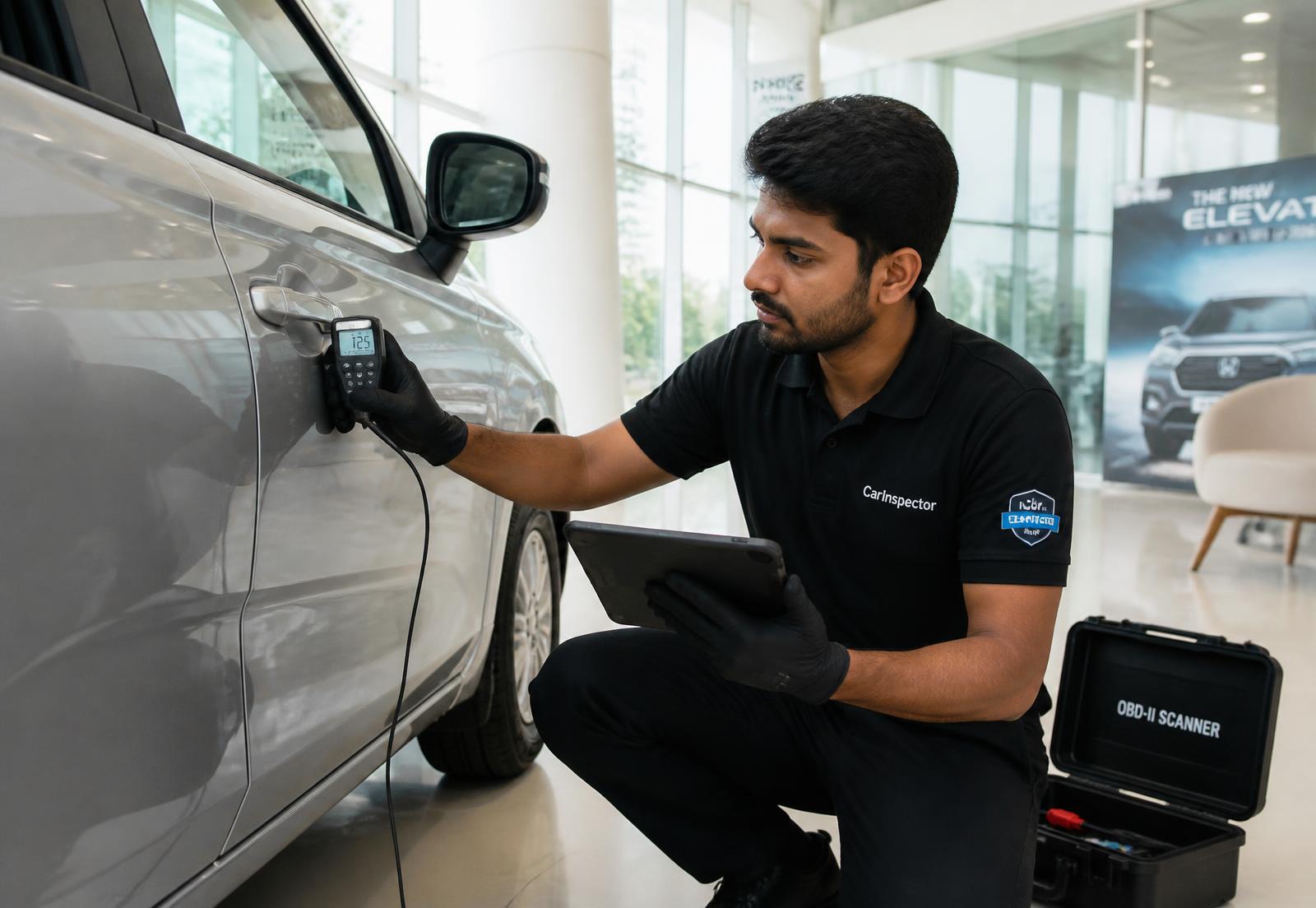
An electronic gauge measures total coating thickness above the metal, usually in microns. The absolute number varies by manufacturer, colour and panel, so the useful signal is not a single reading — it is the pattern across the car.
| Reading pattern | Reasonable interpretation |
|---|---|
| Consistent across all steel panels | Consistent with original factory finish |
| One panel noticeably higher than its neighbours | Panel has likely received additional paint |
| Sharp local spike within a single panel | Possible filler or spot repair underneath |
| Plastic bumpers reading differently from steel | Expected — different substrate and process, compare bumper to bumper |
Where damage usually hides
- Roof and boot lid — rarely checked because most people never look down at the car.
- Lower doors and sills — transport strap and kerb contact.
- Bumper corners and the leading edge of the bonnet.
- Inside door shuts, fuel filler area and the tailgate aperture.
Paint is only one part of a body assessment; panel alignment, glass date codes and underbody condition tell the rest of the story. That whole sequence is part of a full Pre-Delivery Inspection.
Frequently Asked Questions
Want a Professional Paint and Body Inspection?
We measure, document and photograph panel condition before you accept delivery — so nothing is a matter of opinion.
Based on real-world PDI experience. Reviewed by Sure Drives PDI.